
request an appointment
Toll Free – 800 4272
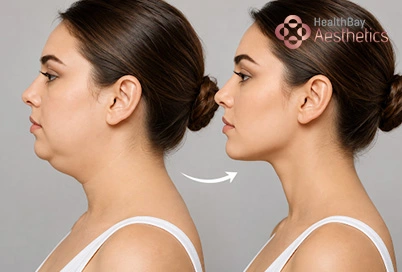
A double chin can develop due to genetics, ageing, weight fluctuations, skin laxity, facial structure, or localized fat. Non-surgical options such as fat-dissolving injections and skin-tightening treatments may help improve the appearance, depending on the underlying cause. A professional assessment is important to determine the most suitable approach.
A defined jawline can enhance facial balance, but fullness beneath the chin can make the lower face appear less defined. While a double chin is often associated with weight gain, it can affect people of different body types and ages.
Genetics, ageing, changes in skin elasticity, facial structure, and localized fat can all contribute to submental fullness. Understanding what is causing the concern is the first step toward choosing an appropriate treatment and achieving natural-looking results.
There is rarely one single explanation for fullness beneath the chin. Several factors can contribute, and more than one may be present at the same time.
Genetics can influence where the body naturally stores fat and how the face and neck are structured.
Some people are naturally more likely to develop submental fullness, even when they maintain a healthy body weight and active lifestyle. If several family members have similar facial characteristics, genetics may be an important factor.
In these cases, losing weight may not completely change the appearance of the area.
Ageing can gradually change the appearance of the lower face and neck.
Over time, collagen and elastin production decreases, which can reduce skin firmness. The effects of gravity and natural changes in facial tissues may also contribute to looseness around the jawline.
As a result, fullness beneath the chin can become more noticeable even without significant weight gain.
Weight gain can increase fat deposits throughout the body, including beneath the chin.
However, localized fat can sometimes remain even after a person reaches or maintains a healthy weight. This is one reason why general weight loss does not necessarily produce the desired definition in the chin and jawline area.
The underlying structure of the face can affect how the chin and neck appear.
A smaller or recessed chin, for example, can make the area beneath the chin look fuller because of the relationship between the chin, jawline, and neck.
This means that the appearance of a double chin is not always related to the amount of fat present.
Loose skin can create fullness even when there is only a small amount of underlying fat.
When skin loses firmness, the transition between the chin and neck can become less defined. In these situations, simply reducing fat may not address the entire concern.
Lifestyle factors can sometimes influence how the area looks from day to day.
Changes in hydration, diet, and fluid retention may temporarily contribute to facial puffiness. However, these temporary changes are different from long-term localized fat or skin laxity.
Understanding this distinction is important before considering an aesthetic procedure.
No.
A double chin can occur in people with different body types and weights. Genetics, ageing, skin elasticity, facial proportions, and localized fat distribution can all contribute.
This is why a person may have a healthy overall weight but still notice fullness beneath the chin.
If weight is not the primary cause, further weight loss may not provide the desired improvement. Instead, a targeted assessment can help determine whether fat, skin laxity, or facial structure is contributing to the appearance.
For suitable candidates, yes.
Modern aesthetic treatments offer non-surgical approaches designed to address localized fullness and improve the appearance of the lower face without surgical incisions.
The most appropriate option depends on what is actually causing the concern.
At HealthBay Aesthetics, the treatment approach is personalized according to factors such as facial anatomy, skin quality, localized fat, and the patient's aesthetic goals.
When localized fat is the primary concern, fat-dissolving injections may be considered.
These treatments are designed to target fat cells in a specific area. The body then naturally processes the treated cells over time, allowing the treated area to gradually appear slimmer.
HealthBay Aesthetics offers fat-dissolving treatments for localized fat deposits and notes that multiple sessions may be recommended depending on the treatment area and individual goals.
Potential advantages include:
This approach may be appropriate when excess fat is the main concern and the skin has reasonable elasticity.
Energy-based technologies, such as Morpheus, may be used to address concerns involving localized fullness and skin firmness.
Depending on the technology, controlled energy can support tissue remodeling and improve the appearance of the treated area.
These treatments can be particularly relevant when mild skin laxity is present alongside localized fullness.
The technology selected should be based on individual anatomy and a professional assessment.
If loose skin is a major contributor, reducing fat alone may not provide the desired result.
Skin-tightening treatments are designed to stimulate collagen remodeling and improve the appearance of skin firmness.
HealthBay Aesthetics offers technologies including Ultherapy, Infini Microneedling, and Morpheus, which may be considered for different skin-tightening and facial rejuvenation concerns.
The right technology depends on the degree of laxity, skin quality, and overall treatment goals.
Some people have both localized fat and skin laxity.
In these cases, combining approaches may provide a more comprehensive improvement than addressing only one concern.
For example, reducing excess fullness may improve the contour while a skin-tightening procedure can focus on firmness.
A combination approach should always be individualized rather than automatically recommended.
Exercises targeting the chin and neck are widely promoted online, but their effect on an established double chin is limited.
Facial and neck exercises may help engage certain muscles, but they cannot selectively remove localized fat.
They also cannot replace professional treatment when significant skin laxity or structural factors are responsible for the appearance.
If the main concern is excess fat, a treatment specifically designed for localized fat reduction is more targeted. If loose skin is the main issue, a skin-tightening approach may be more appropriate.
The right approach begins with identifying what is creating the fullness.
During an assessment, a specialist may consider:
The size and distribution of the fat deposit can influence which treatment is appropriate.
Good skin elasticity may allow the skin to adapt more effectively after fat reduction. More noticeable laxity may require an additional skin-tightening approach.
The chin, jawline, and neck should be considered together. Treating one area without considering the surrounding anatomy can affect the overall balance of the face.
Age-related changes in collagen, elasticity, and tissue structure may influence treatment selection.
Some people want subtle refinement, while others are looking for a more noticeable change in their profile.
A personalized plan helps establish realistic expectations before treatment begins.
Although the exact process depends on the procedure, non-surgical treatment generally involves several stages.
The specialist evaluates the chin, jawline, and neck and identifies the factors contributing to fullness.
The recommended procedure, number of sessions, and expected timeline are discussed.
The selected procedure is performed in a clinical setting. The duration and level of discomfort depend on the technology or treatment used.
Non-surgical approaches generally involve less downtime than surgical procedures. Temporary swelling, redness, tenderness, bruising, or sensitivity can occur depending on the treatment.
Follow-up appointments allow the specialist to evaluate progress and determine whether additional sessions are appropriate.
There is no universal number of sessions.
The treatment schedule can depend on:
For its fat-dissolving treatment, HealthBay Aesthetics notes that patients may require approximately two to four sessions, although the exact plan varies according to the individual and treatment area.
More treatment is not necessarily better. The treatment plan should be adjusted according to the patient's response.
Non-surgical treatments generally produce gradual rather than immediate changes.
With fat-focused procedures, improvement develops as the body processes the treated fat cells. With collagen-stimulating treatments, skin firmness can improve progressively as collagen remodeling takes place.
For fat-dissolving treatments, HealthBay Aesthetics notes that visible improvement may begin within several weeks, with changes continuing to develop over time.
The final timeline varies from person to person.
The outcome depends on the cause of the fullness and the treatment selected.
The goal is a gradual reduction in localized fullness and improved definition beneath the chin.
The focus is on improving firmness and creating a smoother transition between the chin, jawline, and neck.
When both fat and laxity contribute to the concern, addressing both factors may create a more balanced improvement.
The aim should be a natural-looking result that complements the patient's existing facial structure rather than dramatically changing it.
Some people prefer a non-surgical approach, while others may consider surgical fat removal.
| Feature | Non-Surgical Approach | Liposuction |
|---|---|---|
| Procedure type | Non-surgical | Surgical |
| Incisions | No surgical incision | Required |
| Downtime | Generally limited | Longer recovery |
| Treatment sessions | May require multiple sessions | Usually one procedure |
| Results | Gradual | More immediate |
| Best suited to | Localized fullness and suitable anatomy | More significant fat volume or surgical candidates |
Neither approach is automatically better for everyone.
Non-surgical treatment may appeal to people who want to avoid surgery and extended recovery. Liposuction may be considered when a larger amount of fat needs to be removed and the patient is suitable for surgery.
The decision should be based on anatomy, skin quality, treatment goals, health considerations, and personal preferences.
Non-surgical treatment may be suitable for people who:
People with significant skin laxity may require a different approach. A consultation can help determine whether non-surgical treatment is appropriate.
No.
Treatment designed to improve localized fullness beneath the chin is a contouring procedure, not a substitute for weight management.
Someone can maintain a healthy weight and still have localized fullness because of genetics, facial structure, ageing, or fat distribution.
Understanding this distinction can help patients choose realistic treatment goals.
The longevity of results depends on the treatment performed and individual factors.
When an appropriate fat-reduction procedure permanently destroys treated fat cells, those specific cells do not regenerate. However, remaining fat cells can enlarge if significant weight gain occurs.
Maintaining a stable weight and healthy lifestyle can therefore help support the appearance of the treated area.
At the same time, aging continues naturally, so changes in skin firmness can develop over time.
Recovery depends on the procedure.
Non-surgical approaches generally involve less downtime than surgical procedures, but temporary effects can occur.
Possible short-term effects may include:
Patients should follow the aftercare instructions provided by their treating specialist rather than relying on generic advice.
A double chin can have different causes, and treating the wrong factor may lead to less-than-ideal results.
For example, reducing fat may not fully correct an appearance caused mainly by loose skin. Similarly, tightening the skin may not significantly change an area where localized fat is the primary concern.
Choosing the right provider is just as important as choosing the treatment itself. When looking for the best Aesthetic clinic in Dubai, consider the clinic's experience, range of treatments, qualified specialists, consultation process, and approach to personalized treatment planning.
HealthBay Aesthetics takes a personalized approach to treatment selection, considering facial structure, skin quality, localized fat, and the patient's desired outcome.
1. Can a double chin occur even if I am not overweight?
Yes. Genetics, ageing, facial structure, skin laxity, and localized fat distribution can all contribute.
2. Can exercise completely remove a double chin?
Exercise can support overall fitness, but targeted chin exercises cannot selectively eliminate localized fat or significantly tighten loose skin.
3. Is non-surgical treatment suitable for everyone?
No. Suitability depends on factors such as the amount of fat, skin elasticity, facial anatomy, health status, and expectations.
4. How many sessions will I need?
The number varies by treatment and individual response. Some fat-reduction treatments may require multiple sessions.
5. Are the results permanent?
Fat cells treated with appropriate fat-reduction procedures may be permanently eliminated, but remaining fat cells can enlarge with significant weight gain. Natural aging can also continue to affect skin firmness.
6. Can fat reduction and skin tightening be combined?
Yes. When both localized fat and skin laxity contribute to the appearance, a combination approach may be considered.
7. Is liposuction better than non-surgical treatment?
Not necessarily. Liposuction and non-surgical procedures have different benefits, limitations, recovery periods, and suitability criteria. The appropriate choice depends on individual anatomy and goals.
A double chin is not always a reflection of body weight. Genetics, aging, skin laxity, facial structure, and localized fat can all influence the appearance of the area beneath the chin.
The key to achieving a natural-looking improvement is understanding what is actually causing the fullness before choosing a treatment.
For suitable candidates, non-surgical approaches can provide targeted improvement without the recovery associated with surgery. Depending on the individual, treatment may focus on localized fat reduction, skin tightening, or a combination of both.
If you are considering double chin reduction in Dubai, a professional consultation at HealthBay Aesthetics can help determine which approach is appropriate for your anatomy, skin quality, and aesthetic goals. Book your consultation today.
Book an Appointment