
request an appointment
Toll Free – 800 4272
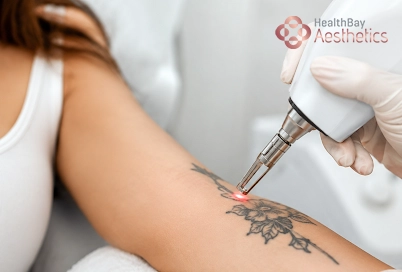
Thinking about tattoo removal in Dubai? Modern laser technology safely breaks down tattoo ink over multiple sessions, allowing your body to gradually eliminate the pigment. Understanding the treatment process, expected sessions, and proper aftercare can help you achieve the best possible results while supporting healthy skin.
Tattoos often represent meaningful moments, creativity, or personal milestones. However, as life changes, many people decide they no longer want a particular tattoo. Whether it's for professional reasons, a lifestyle change, or to make room for a new design, modern laser tattoo removal offers a safe and effective solution.
At HealthBay Aesthetics our tattoo removal treatment uses medical-grade laser platforms to target ink pigment while protecting the surrounding skin. Here's what the process actually involves, from the science behind the laser to the sessions you'll need and how to care for your skin afterward.
Laser tattoo removal uses advanced laser energy to target tattoo pigments beneath the skin. The laser delivers short pulses of light that break the ink into microscopic particles without significantly affecting the surrounding skin.
Once the pigment is fragmented, your body's immune system gradually removes these particles over the following weeks, causing the tattoo to fade progressively. Because this process occurs naturally, multiple treatment sessions are usually required to achieve optimal fading.
Not all lasers are created equal, and pigment removal is a specialty in itself. At HealthBay Aesthetics, our dermatology team selects from advanced platforms like Spectra Laser, offering different wavelengths suited to specific ink colors, depths, and skin tones.
This dual- and multi-wavelength capability matters because a single laser type rarely handles every tattoo well. Matching the right wavelength to your ink color and skin type is what separates a controlled, even fade from uneven results or unnecessary sessions.
One of the most common questions patients ask is, "How many laser tattoo removal sessions will I need?"
There isn't a single answer because every tattoo responds differently.
The number of sessions depends on:
Larger tattoos generally require more treatment sessions than smaller ones.
Black ink usually responds the fastest to laser treatment. Green, blue, yellow, and white pigments may require additional sessions because they absorb laser energy differently.
Older tattoos often fade more quickly since some pigment has already broken down naturally over time.
Professional tattoos typically contain deeper, denser ink than amateur tattoos, which may increase the number of sessions required.
Your dermatologist will customise laser settings according to your skin tone to maximise effectiveness while reducing the risk of pigmentation changes.
Since your immune system clears the fragmented ink particles, overall health and healing capacity can influence how quickly the tattoo fades.
Most patients require several sessions spaced several weeks apart to allow the skin to heal and the body to remove the shattered pigment naturally.
A typical appointment includes:
Your practitioner evaluates:
The treatment area is cleaned thoroughly, and protective eyewear is provided.
The laser delivers rapid pulses over the tattoo. Many patients describe the sensation as similar to a rubber band snapping against the skin.
Treatment time varies depending on the tattoo size, ranging from just a few minutes for small tattoos to longer sessions for larger designs.
Cooling measures may be applied immediately after treatment to reduce redness and improve comfort.
Many patients expect immediate tattoo removal after one treatment, but fading happens gradually. During the weeks following your session, your body's immune system works to clear the fragmented ink particles. You may notice the tattoo looking slightly darker, lighter, or even frosted immediately after treatment, which is a normal response.
Over the next 6–8 weeks, the tattoo gradually fades before your next session. Each appointment builds on the progress of the previous one, resulting in steady improvement while allowing the skin enough time to heal safely.
Pain tolerance varies from person to person.
Most individuals describe the discomfort as manageable and temporary. The sensation generally lasts only during the laser pulses, and any post-treatment sensitivity typically subsides within a short period.
Most patients begin noticing gradual fading after their first few sessions, although the rate of improvement varies depending on the tattoo and individual healing response. Older tattoos and those with black ink often respond faster than newer, multicoloured tattoos.
After each session:
Complete removal cannot always be guaranteed, as outcomes depend on several factors, including tattoo colour, depth, age, and individual healing response. However, many tattoos fade significantly enough for complete removal or successful cover-up work.
Proper aftercare helps minimise side effects and promotes better healing. For the first few days after treatment, it is recommended to avoid:
Gently cleanse the treated skin using mild soap and water.
Minor blistering or scabbing can occur. Allow the skin to heal naturally without disturbing the area.
Avoid direct sunlight and use broad-spectrum sunscreen once healing allows, as UV exposure may increase the risk of pigmentation changes.
For the first few days, avoid:
Use only the healing products recommended by your practitioner.
Spacing sessions appropriately allows the skin to recover and gives your immune system time to remove fragmented ink effectively.
Laser tattoo removal is generally considered safe when performed by experienced professionals.
Temporary side effects may include:
These reactions usually resolve as the skin heals. Following professional aftercare instructions significantly reduces the likelihood of complications.
You may be a suitable candidate if you:
A consultation with an experienced aesthetic practitioner will determine whether laser tattoo removal is appropriate for your individual needs.
At HealthBay Aesthetics tattoo removal treatments are personalized based on your tattoo characteristics, skin type, and desired outcome. Using advanced medical-grade laser technology, the team focuses on safe, gradual ink reduction while prioritising skin health throughout every stage of treatment.
1. Can I return to work after laser tattoo removal?
Yes. Most people can return to their normal daily activities immediately after treatment. However, you should follow your practitioner's aftercare advice and avoid activities that may irritate the treated area, such as intense exercise, swimming, or excessive sun exposure for the recommended period.
2. Can laser tattoo removal be performed on any part of the body?
Laser tattoo removal can be performed on most areas of the body, including the arms, legs, back, chest, and ankles. During your consultation, your practitioner will assess the tattoo's location and recommend the most appropriate treatment approach.
3. Is laser tattoo removal painful?
Most people describe the sensation as similar to the snap of a rubber band against the skin. Any discomfort is temporary, and cooling techniques may be used to improve comfort during the procedure.
4. Can all tattoo colours be removed?
Most tattoo colours can be treated with advanced laser technology. Black ink typically responds the fastest, while colours like green, blue, yellow, and white may require additional sessions.
5. Will laser tattoo removal leave a scar?
When performed by experienced professionals using advanced laser technology and followed by proper aftercare, the risk of scarring is minimal. Existing scars from the original tattoo process may still remain.
6. What should I do after a laser tattoo removal session?
Keep the treated area clean, avoid picking at scabs or blisters, protect the skin from sun exposure, follow your practitioner's aftercare instructions, and attend all scheduled follow-up sessions.
7. How long should I wait between tattoo removal sessions?
Most patients wait around 6–8 weeks between sessions to allow the skin to heal and the body to naturally eliminate the broken-down ink particles.
8. Can I remove only part of a tattoo?
Yes. Laser tattoo removal can be customised to target specific sections of a tattoo, making it suitable for partial removal or preparing the area for a tattoo cover-up.
Whether you're looking to completely remove an old tattoo or lighten it for a cover-up, HealthBay Aesthetics offers advanced laser tattoo removal tailored to your skin type and tattoo characteristics. Our experienced team will assess your tattoo, explain the expected treatment journey, and create a personalised plan to help you achieve the best possible results safely.
Book your consultation at HealthBay Aesthetics today and take the first step toward clearer, healthier-looking skin.
Book an Appointment